
While most SaaS companies spend millions on marketing to reach their first $10M ARR, Swedish AI startup Lovable achieved $100M ARR in just 8 months without a single dollar spent on paid acquisition.
With only 45 employees, that’s $2.2M revenue per employee, crushing the industry benchmark of $200K that most SaaS companies celebrate.
This AI-powered app builder didn’t stumble into success. They orchestrated one of the most sophisticated multi-channel growth strategies ever executed, running 12+ channels simultaneously while competitors struggled with one or two.
In this article, we’ll break down how Lovable turned open source credibility, product-led growth, and community virality into the fastest revenue climb in software history.
Lovable’s Explosive Growth
Before we dive into tactics, let’s look at what Lovable actually achieved.
In November 2024, Lovable launched its commercial platform. By February 2025, they hit $17M ARR. By July 2025, they crossed $100M ARR.
Here’s the full picture:
- $100M ARR in 8 months (November 2024 – July 2025)
- $17M ARR in first 90 days
- 180,000 paying subscribers
- 2.3M+ active users
- 10M+ projects created on the platform
- 45 full-time employees
- $200M Series A at $1.8B valuation (July 2025)
- Zero dollars spent on paid marketing
This subfolder of growth tactics now generates over $2.2M per employee annually, worth an estimated efficiency rate that most venture-backed startups dream about. Plus, the approach bolsters Lovable’s overall market position with massive word-of-mouth momentum and user-generated content that compounds daily.
In other words, Lovable’s multi-channel orchestration isn’t just impressive, it’s a masterclass in how AI-native companies can scale without traditional marketing playbooks.
The platform targets non-technical founders, product managers, and developers who need to build web apps quickly. By dominating multiple channels simultaneously, Lovable ranks for everything from “AI app builder” to “GPT Engineer” to branded searches. This leads to more qualified signups and, ultimately, faster conversion to paid plans.
Four Growth Strategies That Powered Lovable’s Rise
To understand how Lovable executed this growth playbook, we need to look at four interconnected strategies that created compounding effects.
1. Open Source as Distribution: Build Community Before Product
The story begins in mid-2023, before Lovable even existed as a commercial product.
Co-founder Anton Osika, then CTO at Depict.ai, spent one weekend building GPT Engineer, a command-line tool that could generate entire codebases from natural language prompts. He released it as open source on GitHub.
The response was explosive. GPT Engineer became the fastest-growing repository in GitHub history, hitting 50,000 stars in just two months.
This wasn’t just vanity metrics. Those 50,000 stars represented 300,000 developers who experimented with the tool, gave feedback, contributed code, and most importantly—spread the word across Twitter, Reddit, and developer forums.
By the time Lovable launched the commercial web version in November 2024, they already had 27,000 people on the waitlist. The open source project had created instant credibility and a built-in distribution channel that most startups spend years and millions trying to build.
This approach mirrors successful strategies from companies like HashiCorp and MongoDB, who used open source to build developer trust before monetizing with hosted services. The key insight: give massive value first, then convert goodwill into customers.
The result? When Lovable opened to the public, they had 300,000 advocates ready to become early adopters. Week one generated $1M in revenue. By week four, they hit $4M.
2. Product-Led Growth Engineered for Virality
While the open source community provided initial momentum, Lovable didn’t rely on hope that users would share. They actively engineered virality into the product itself.
The free tier was strategically designed to maximize conversion. Users could access all features but with generation limits—5 credits daily, or 50 per month. The experience was smooth until you hit that limit, at which point the UX made one thing crystal clear: upgrading was the natural next step.
This isn’t accidental. It’s textbook product-led growth, and the conversion data proves it works. Lovable maintains 85% retention among paying users after the first month—a metric that would make most SaaS founders jealous.
But the real genius came from features designed specifically to encourage sharing.
The Launched Showcase
Lovable created “Launched” (launched.lovable.dev), a dedicated platform where users submit apps they built with Lovable and the community votes on favorites. It’s essentially a mini Product Hunt for Lovable creations.
The gamification worked perfectly. The top 5 projects each week win free credits, incentivizing users to share their work publicly. Every submission becomes social proof. Every upvote creates engagement. Every winner becomes a case study.
The Social Proof Loop
Lovable maintains constant visibility on X (Twitter) by:
- Publishing real-time growth metrics (ARR, user count, project numbers)
- Resharing user-created apps almost daily
- Celebrating community wins publicly
- Engaging directly with the AI and developer communities
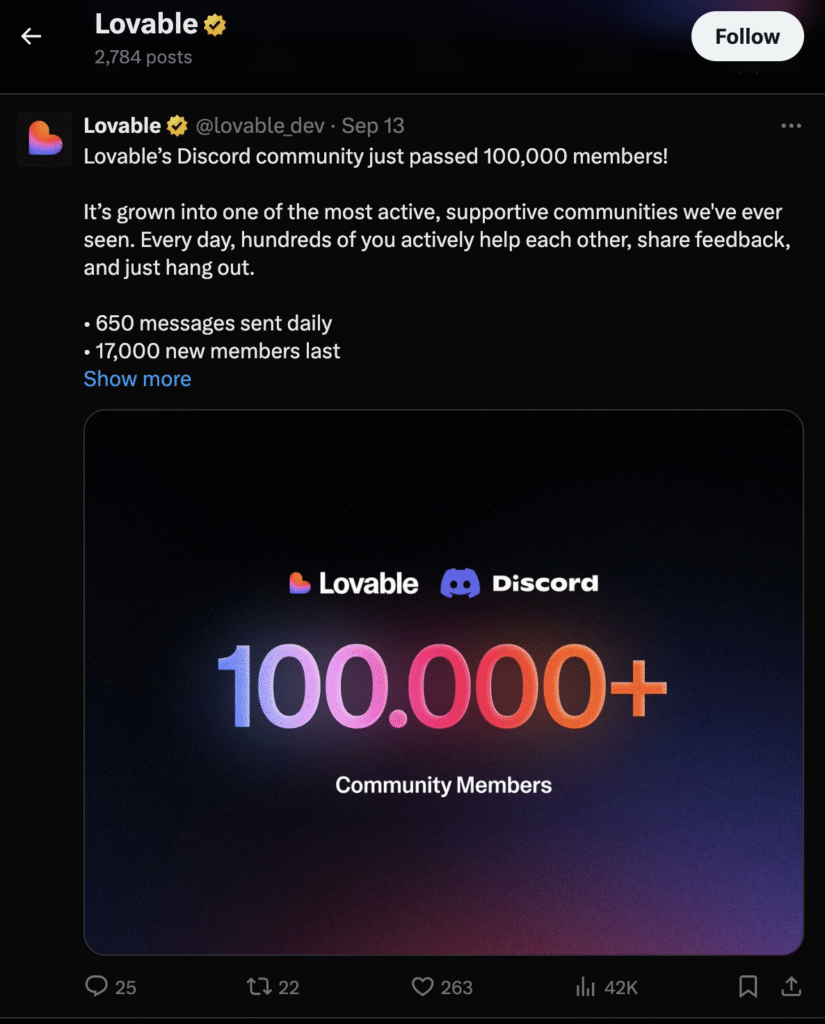
This creates a powerful FOMO effect. The more Lovable and its users share about explosive growth, the more people want to try it. The more people try it, the more content gets created. The cycle compounds.
With over 1,000 builds processed daily and 2,800% year-over-year growth, the product itself became the primary marketing engine.
3. Multi-Channel Orchestration: Running 12+ Channels Simultaneously
Here’s where Lovable separated itself from every competitor.
While tools like Cursor and Bolt.new focused on one or two primary channels, Lovable built a growth machine that operated across more than 12 channels at the same time.
Lovable’s distribution spans:
- Twitter/X (constant engagement with dev community)
- Product Hunt (dominated homepage for multiple days)
- GitHub (50K+ stars, ongoing community)
- Reddit (r/webdev, r/SideProject, r/entrepreneur)
- Hacker News (multiple front-page features)
- Dev.to and other developer forums
- Podcasts (Lenny’s Podcast, Create Like The Greats)
- HubSpot (content partnerships)
- Google organic search
- User-generated content (10M+ projects)
- Tech influencer amplification
- Real-time case studies and testimonials
Most startups struggle to execute even three channels well. Lovable didn’t just run 12—they optimized all of them simultaneously.
The key was having a small, focused team of 45 people who understood that every channel fed the others. A Product Hunt launch drove GitHub stars. GitHub credibility led to podcast invitations. Podcast appearances created Twitter momentum. Twitter engagement drove more Product Hunt upvotes.
Each channel created content and credibility that fueled the next, building a flywheel that required no paid advertising to maintain momentum.
4. Strategic Pricing Built for Scale
The pricing strategy revealed Lovable’s confidence in long-term growth over short-term revenue extraction.
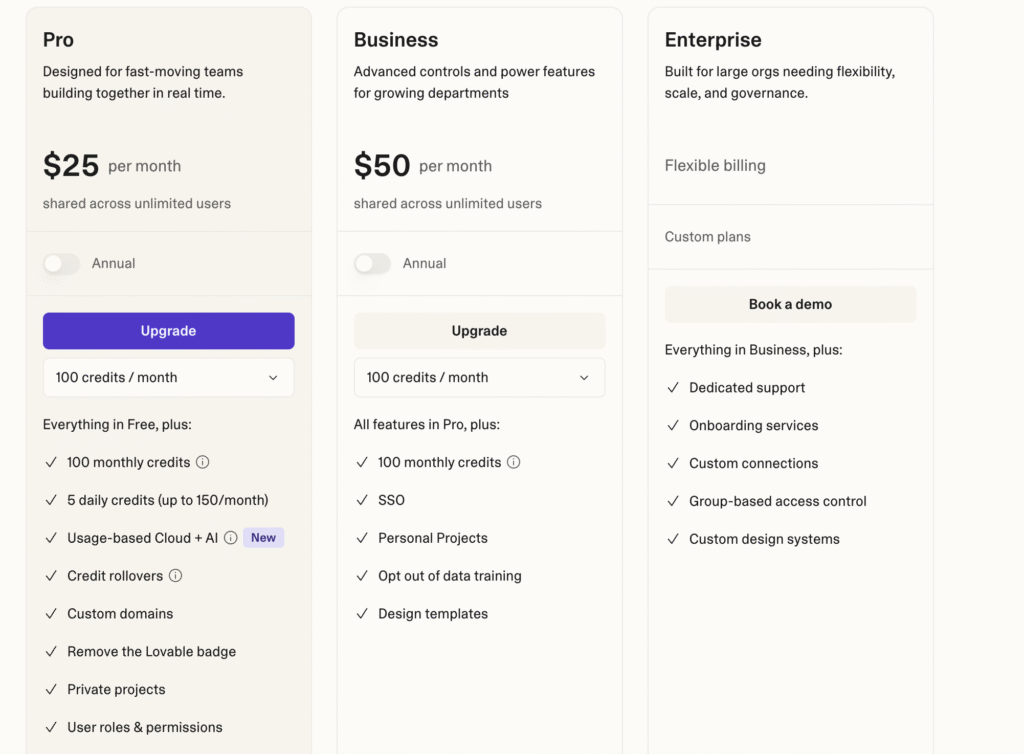
They use a credit-based model (not token-based like many AI competitors):
- Free tier: 5 credits daily (50 per month)
- Pro: $25/month for 100 monthly credits
- Business: $50/month for expanded features
- Enterprise: Customized plan with dedicated support and many other features.
The most telling move came in June 2025, when CEO Anton Osika announced they had “lost $1.5 million ARR in a single day” by migrating all Team tier users to the less expensive Pro tier—which now includes collaboration features.
Why sacrifice $1.5M in revenue?
Because accessibility and user growth matter more than short-term optimization. This is classic product-led growth thinking at scale: maximize the number of users having great experiences, and revenue will follow.
The bet paid off. By July, Lovable had crossed $100M ARR, and early enterprise customers like Klarna, HubSpot, and Photoroom had signed on—validating that the platform works for production applications, not just prototypes.
Light on Technical Complexity, Heavy on Business Value
While Lovable’s underlying technology is sophisticated, the marketing never buried prospects in jargon.
They mention that the platform uses multi-LLM orchestration—GPT-4 Mini for speed tasks and Claude for complex reasoning. They highlight one-click deployment, GitHub integration, and Supabase connectors for databases.
But they don’t dwell on transformer architecture, training methodologies, or token optimization strategies.
Instead, every feature is framed around business outcomes:
- “Build a working app in minutes, not weeks”
- “No coding experience required”
- “Deploy instantly with one click”
- “Integrate with your existing tools”
This keeps the message accessible to the 99% of potential users who aren’t AI researchers—founders, product managers, designers, and marketers who need to ship apps quickly.
The same principle guided their integrations strategy. Lovable connected with tools users already know:
- Figma (import designs and turn them into functional apps)
- GitHub (version control and code export)
- Supabase (backend and database management)
These integrations position Lovable as part of the complete app development journey, not just a code generation toy.
The Fastest Path to $100M Isn’t Always the Obvious One
Lovable’s success challenges conventional SaaS wisdom.
They didn’t hire a large sales team. They didn’t spend millions on paid acquisition. They didn’t raise a massive Series A before proving product-market fit.
Instead, they:
- Built community first through open source (6+ months of goodwill before monetization)
- Engineered virality into core product features (Launched showcase, credit system, sharing incentives)
- Executed 12+ growth channels simultaneously (while competitors focused on 1-2)
- Prioritized user experience over short-term revenue (sacrificing $1.5M ARR for accessibility)
- Stayed lean with 45 employees (forcing focus and efficiency)
The results speak for themselves: $100M ARR in 8 months, 180,000 paying customers, and a $1.8B valuation—all without traditional marketing spend.
For B2B SaaS founders, the lesson is clear: in the AI era, the fastest growth comes from building something people genuinely love and making it effortless for them to share it.
Want to track AI funding trends? Check our weekly AI funding roundups for comprehensive coverage of the latest investments.
