
Every founder starts their cap table in a spreadsheet. It is free, it is familiar, and for a while it works fine. The problem is not that spreadsheets are bad. The problem is that they quietly stop being enough, and you usually find out at the worst possible moment, when an investor’s lawyer is reading your cap table line by line during a Series A.
This guide covers exactly where spreadsheets fail, why diligence is where the cracks show, and how to tell you have already outgrown yours.
Why a spreadsheet works at first
At the start there is not much to track. A couple of founders, maybe an advisor, a clean split. A spreadsheet handles that easily, and reaching for dedicated software on day one would be overkill.
So this is not an argument against ever using a spreadsheet. It is an argument about timing. The spreadsheet is fine right up until the number of moving parts grows past what a person can track by hand without slipping. That point arrives sooner than most founders expect.
Where spreadsheets actually break
The failures are not dramatic. They are small errors that sit unnoticed until something forces a close look. Here is what tends to go wrong.
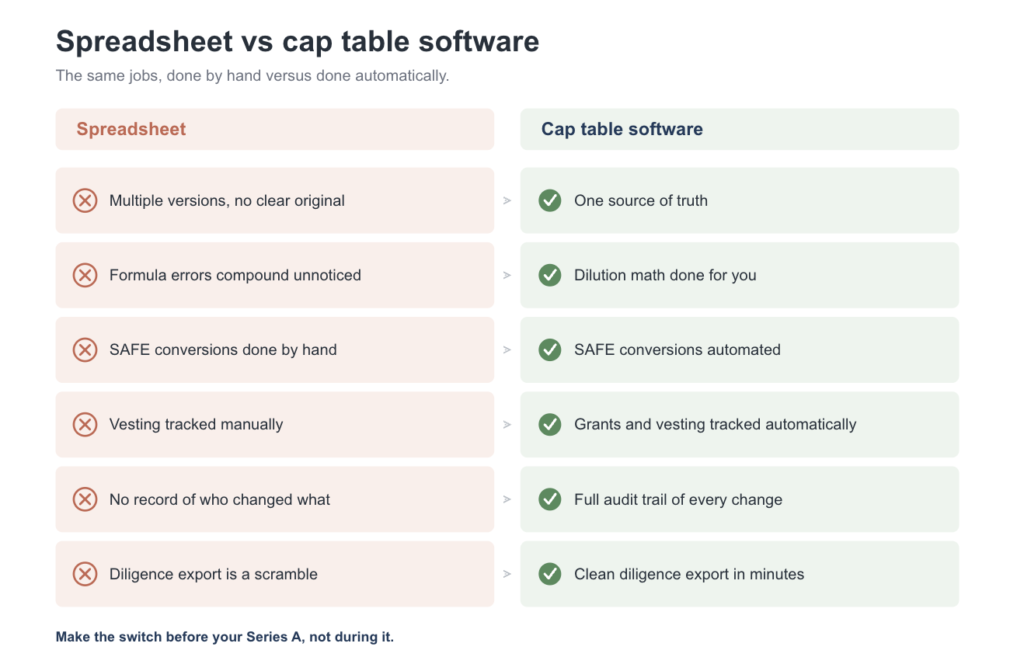
Version control. You email the spreadsheet to your lawyer. They edit it. You edit your own copy at the same time. A co-founder saves a third version. Now there are three files and no clear answer to which one is real. This sounds minor until an investor asks for the current cap table and you are not sure which file to send.
Formula errors that compound. One wrong cell reference early on flows into every calculation after it. Because the spreadsheet still produces a confident looking number, nobody notices. The error only surfaces when someone checks the math against the actual signed documents.
SAFE and note conversion. This is the big one. When you have raised on several SAFEs at different caps, working out how they convert at a priced round is genuinely hard to do by hand. Get it wrong and your ownership numbers are off, your investors’ numbers are off, and the mistake is baked into the round before anyone catches it.
Option grants and vesting. Every grant has a start date, a cliff, a vesting schedule, and sometimes an early exercise or an early departure. Tracking all of that across a growing team in a spreadsheet means updating it by hand every single time, and one missed update means your fully diluted math is quietly wrong.
No audit trail. A spreadsheet does not remember who changed what, or when. When an investor asks you to prove a number is correct, you cannot point to a record. You can only point to more spreadsheet.
Why Series A is where it snaps
Seed rounds are often light on diligence. A SAFE or a priced seed can close without anyone stress testing your cap table.
Series A is a different animal. Now there is a lead investor writing a large check, and their lawyers go through your ownership records in detail. They check that every share, option, SAFE, and note is accounted for. They check that the math is internally consistent. They check that what the cap table says matches what the signed documents say.
If your spreadsheet has drifted from reality, this is where it shows. And it shows at the exact moment you have the least room to deal with it, in the middle of a live round with a term sheet on the clock.
What a broken cap table actually costs
The cost is rarely just the error itself. It is what the error does to the round.
It slows you down. Diligence stalls while everyone works out what the real numbers are, and a deal that felt done starts to drag.
It can change the terms. If the cap table was wrong in a way that affected ownership, fixing it can mean renegotiating who owns what, which is an awkward conversation to have with money on the table.
It costs legal fees. Untangling a messy cap table under deadline pressure is exactly the kind of work lawyers bill a lot of hours for.
And it costs trust. A sloppy cap table makes an investor wonder what else is sloppy. That is not the impression you want to give the person about to fund your company.
Signs you have already outgrown the spreadsheet
You do not need to wait for a round to know it is time. Any one of these is a good signal.
You have granted options to employees. You have raised on more than one or two SAFEs. You are not fully sure your spreadsheet matches your signed documents. You have more than one version of the file floating around. You are planning to raise in the next 6 to 12 months. Or you had to stop and think for more than a few seconds about who owns what, fully diluted, right now.
If any of those are true, the spreadsheet has already turned into a liability. The only question left is whether you fix it calmly now or under pressure later.
What software actually fixes
Dedicated cap table software is not magic, but it removes the specific failure points above.
It keeps one source of truth, so there is never a question of which file is real. It does the dilution and conversion math for you, including the hard SAFE conversions, so the numbers stay consistent by default. It tracks every option grant and vesting schedule automatically. It keeps a record of changes, so you can show an investor exactly how a number came to be. And when diligence starts, it produces a clean export in minutes instead of a weekend of scrambling.
The result is that your cap table stops being something you hope is right and becomes something you know is right. During a raise, that difference is worth a lot.
The bottom line
Spreadsheets are the right tool for the first few months and the wrong tool the moment real equity starts moving. The break rarely announces itself. It waits until diligence, when the cost of a mistake is highest, and then it shows up all at once.
The move is simple, and it feels optional right up until it isn’t. Switch to real software once you have your first option grants or your first outside money, well before your Series A, so that when the lawyers come looking, your cap table is boring, clean, and correct.
